Evaluation of Object Detection Models for PCB Defect Detection
Authors
- Ashwin Girish
- Keerthiveettil Vivek
Dataset
The dataset used in our experiments is DeepPCB.
- Size: 1,500 image pairs (train: 1,000, test: 500)
- Resolution: 640×640 cropped from ~16k×16k scans
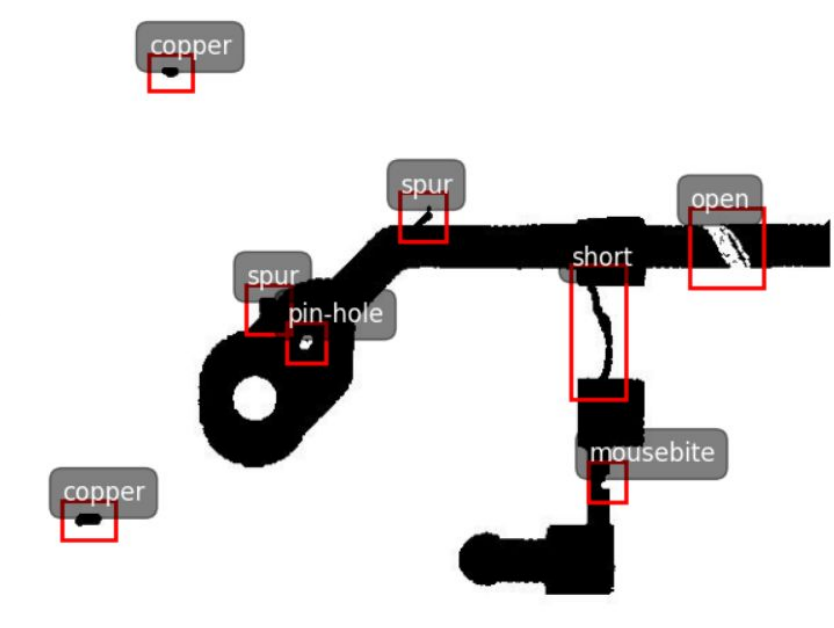
- Classes: Six PCB defect types — open, short, mousebite, spur, copper, and pin-hole.
- Format: Each test image is annotated with bounding boxes in VOC/YOLO format.
Model(s)
The project benchmarks three families of detectors:
- YOLO (v5 & v11): Anchor-based (v5) and anchor-free (v11) single-stage detectors.
- Faster R-CNN: Two-stage detector with Region Proposal Network (RPN).
- DETR: Transformer-based end-to-end detector without anchors.
Results (Light Augmentation)
Below are the results under the Light augmentation policy, which yielded the best overall performance across models:
| Model | Epochs | Precision | Recall | mAP@50 |
|---|---|---|---|---|
| YOLOv11 | 50 | 0.937 | 0.930 | 0.964 |
| Faster R-CNN | 50 | 0.847 | 0.959 | 0.926 |
| DETR | 50 | 0.978 | 0.978 | 0.932 |
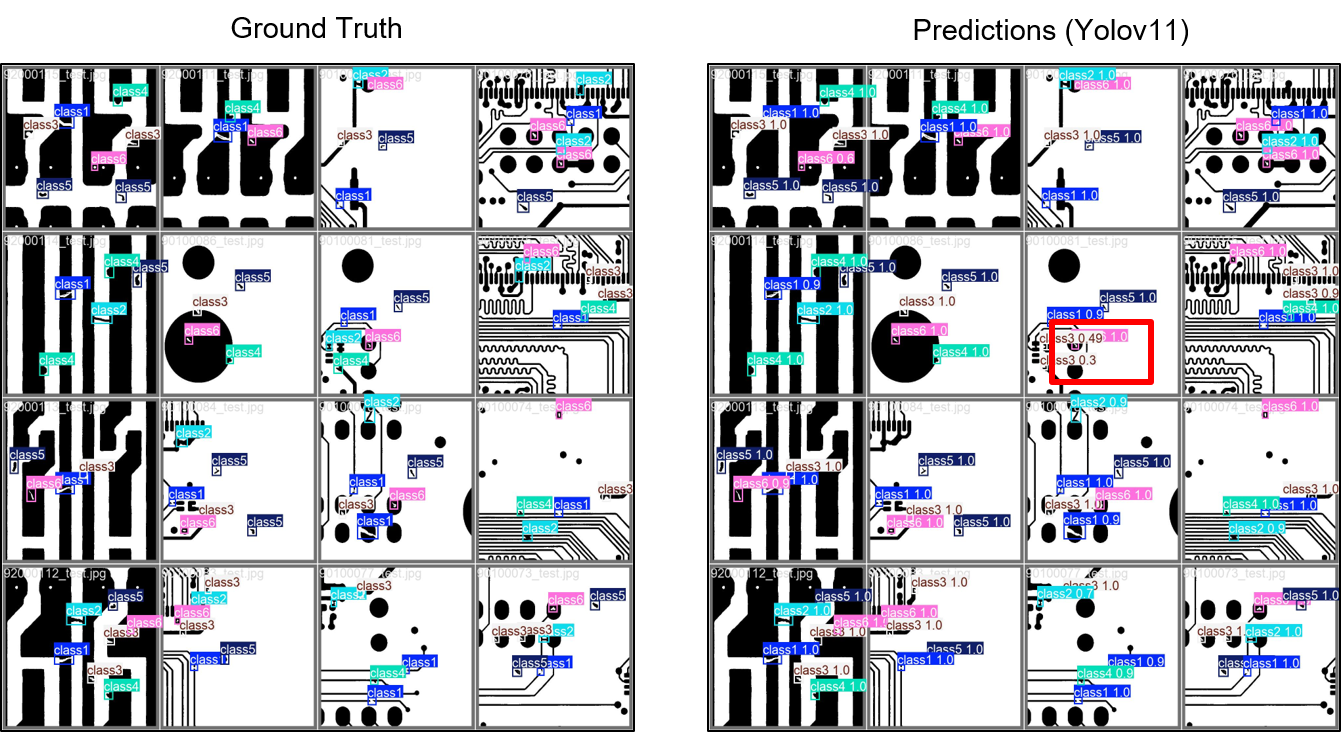
- YOLOv11: Best overall balance, achieving the highest mAP@50.
- Faster R-CNN: Recall-heavy, detects most defects but generates more false positives.
- DETR: Very strong precision and recall, but slightly weaker mAP due to localization issues.
Results (Anchor experiments)
| Model | Epochs | Precision (Default) | Recall (Default) | mAP@50 (Default) | Precision (Custom) | Recall (Custom) | mAP@50 (Custom) |
|---|---|---|---|---|---|---|---|
| YOLOv5 | 50 | 0.954 | 0.919 | 0.962 | 0.948 | 0.935 | 0.967 |
| Faster R-CNN | 50 | 0.894 | 0.965 | 0.955 | 0.828 | 0.974 | 0.969 |
- YOLOv5: Consistently strong precision-recall balance; custom anchors slightly improved recall and mAP@50 but with a small drop in precision.
- Faster R-CNN: Recall-oriented; detects nearly all defects, but precision dropped sharply with custom anchors, indicating more false positives despite a gain in mAP@50.