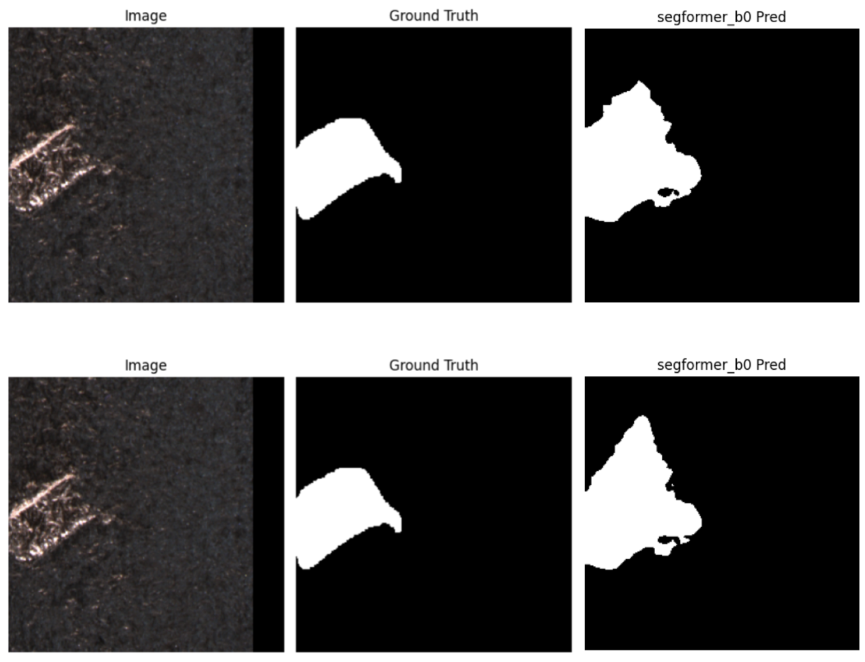
Surface defect detection
Authors
- Srishti, Patwal
- Dixit, Rikhari
Dataset
The dataset used in our experiments is KolektorSDD2.
- Contains high-resolution surface defect images from industrial settings.
- Includes defective (positive) and non-defective (negative) samples.
- Images were cropped into 256×256 patches.
- Data imbalance tackled via positive-centered sampling and augmentation.
Model(s)
We employed a model zoo of segmentation architectures:
- FCN-ResNet50
- U-Net (ResNet50 backbone)
- DeepLabV3-ResNet50
- SegFormer-B0
Each model was trained with Dice + BCE combo loss, dynamic positive weighting, and discriminative learning rates.
Results
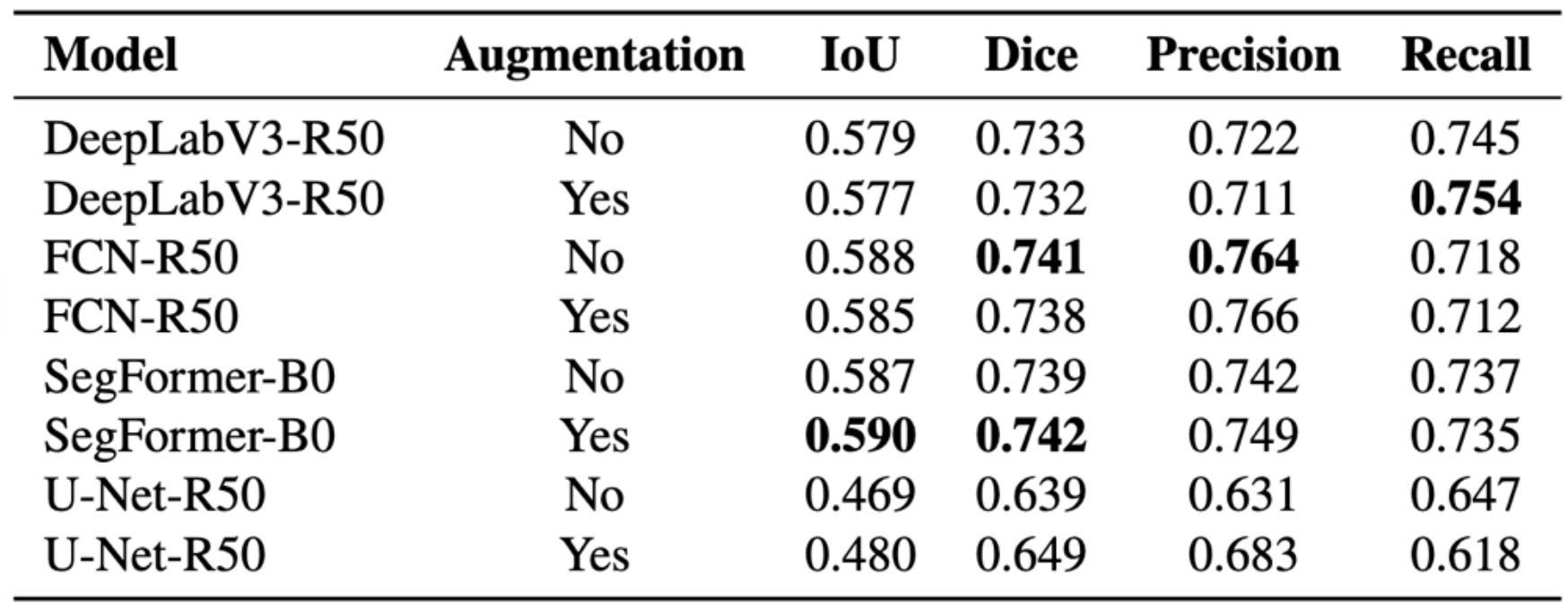
Quantitative results. All models were trained with dynamic positive weighting. The best results per column are highlighted in bold.
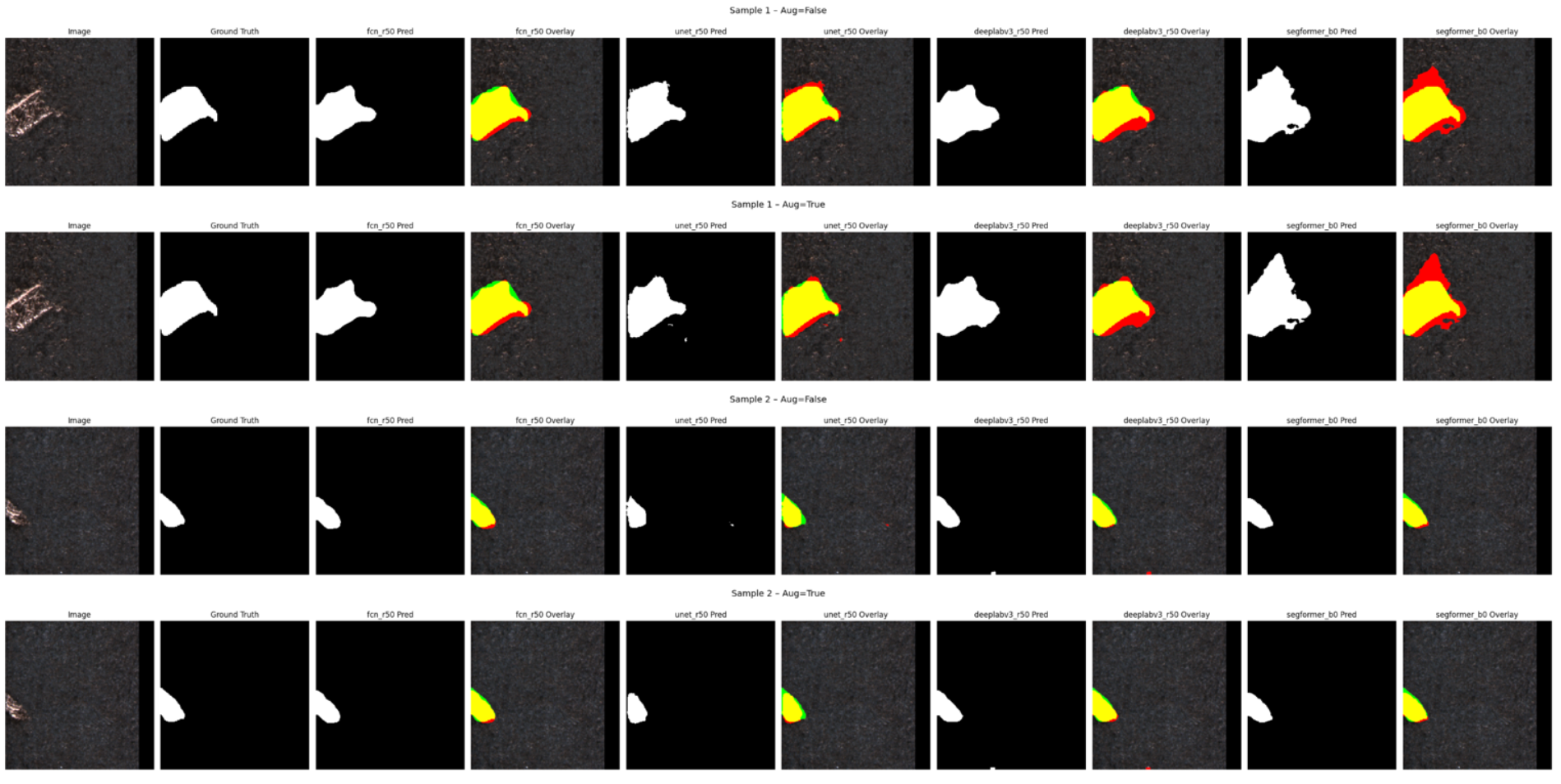
Qualitative results. From left to right: input, ground truth, and predictions and overlays from FCN-R50, U-Net-R50, DeepLabV3-R50, SegFormer-B0, with and without data augmentation. Overlay masks: True Positives (yellow), False Positives (red), and False Negatives (green).
Summary:
- Best IoU & Dice → FCN-ResNet50
- Best Recall → DeepLabV3-R50
- Best Precision → SegFormer-B0
- U-Net underperformed compared to other models.